LangBot v4.9.0: Full RAG Plugin Architecture — Knowledge Without Borders
LangBot v4.9.0, codenamed “Knowledge Without Borders,” does exactly what the name says: the entire knowledge base capability has been refactored from a built-in implementation to a plugin-driven architecture.
This isn’t a minor tweak — it redefines what “knowledge” means in LangBot.
The Problem with the Old Approach
Before v4.9.0, LangBot’s knowledge base was split into two separate systems:
- Built-in Knowledge Base: Used Chroma as the vector database, with embedding models managed by LangBot directly. Document parsing, chunking, and indexing were all hardcoded.
- External Knowledge Base: Bridged services like Dify, RAGFlow, and FastGPT through the
KnowledgeRetrieverplugin component — retrieval only, no document ingestion.
These two systems lived behind separate UI tabs, with completely different data models and management flows.
Why this was painful:
- Poor extensibility: Want a different vector database? A custom chunking strategy? Sorry, that’s hardcoded.
- High maintenance cost: Every RAG improvement required changes to LangBot’s core code and a new release.
- Fragmented UX: Two completely different knowledge base management flows meant a steep learning curve.
v4.9.0 solves this decisively: extract RAG capabilities from LangBot’s core and hand them to plugins.
What Changed
1. Unified Knowledge Base Model
The internal / external distinction is gone. All knowledge bases are managed through a single interface, differentiated only by their rag_engine_plugin_id. One list, one creation flow — just pick your engine.
2. KnowledgeEngine Component
This is the headline addition. KnowledgeEngine replaces the old KnowledgeRetriever and takes ownership of the full knowledge base lifecycle:
- Document Ingestion: The complete pipeline from file parsing to vector indexing
- Knowledge Retrieval: Returning relevant chunks at query time
- Document Deletion: Cleaning up documents and their associated vector data
- Lifecycle Hooks: Callbacks when knowledge bases are created or deleted
A KnowledgeEngine plugin has full control over indexing and retrieval strategies — not just retrieval.
3. Parser Component
Document parsing has been extracted into its own plugin component type. A Parser converts binary files (PDF, Word, Markdown, etc.) into structured text, which is then handed to the RAG engine for chunking and indexing.
The data flow:
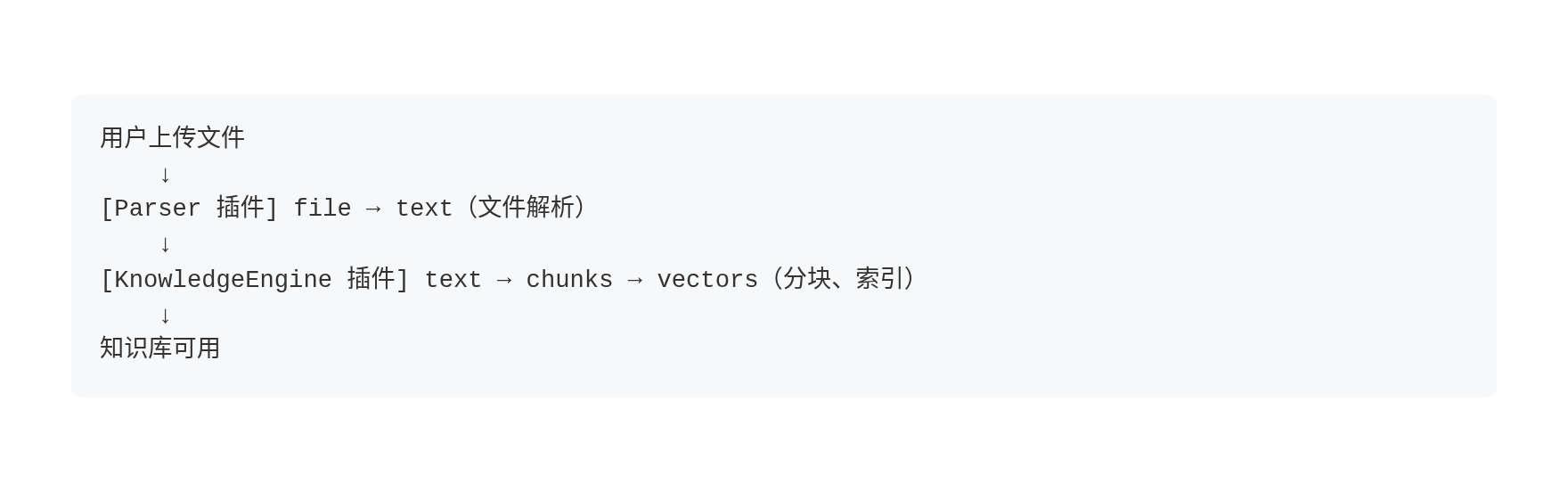
If a RAG engine declares DOC_PARSING capability, it can handle parsing internally and skip the external Parser.
4. Host RAG API
LangBot’s core no longer executes RAG operations directly, but it still provides essential infrastructure through RAGRuntimeService, accessible to plugins via RPC:
- Embedding invocation:
invoke_embedding()— plugins don’t need to manage model connections - Vector database operations:
vector_upsert()/vector_search()/vector_delete() - File access:
get_knowledge_file_stream()— read raw files from storage
This means plugins can focus on RAG strategy (chunking algorithms, retrieval logic, re-ranking) while the host handles the “heavy” operations like vector storage and embedding models.
5. KnowledgeRetriever Deprecated
The old KnowledgeRetriever component has been removed. If you had external knowledge base plugins, they’ll need to migrate to KnowledgeEngine. The good news: the new API is cleaner and migration is straightforward.
Building a RAG Engine Plugin
Scaffold the Component
lbp comp KnowledgeEngineThis generates the directory structure:
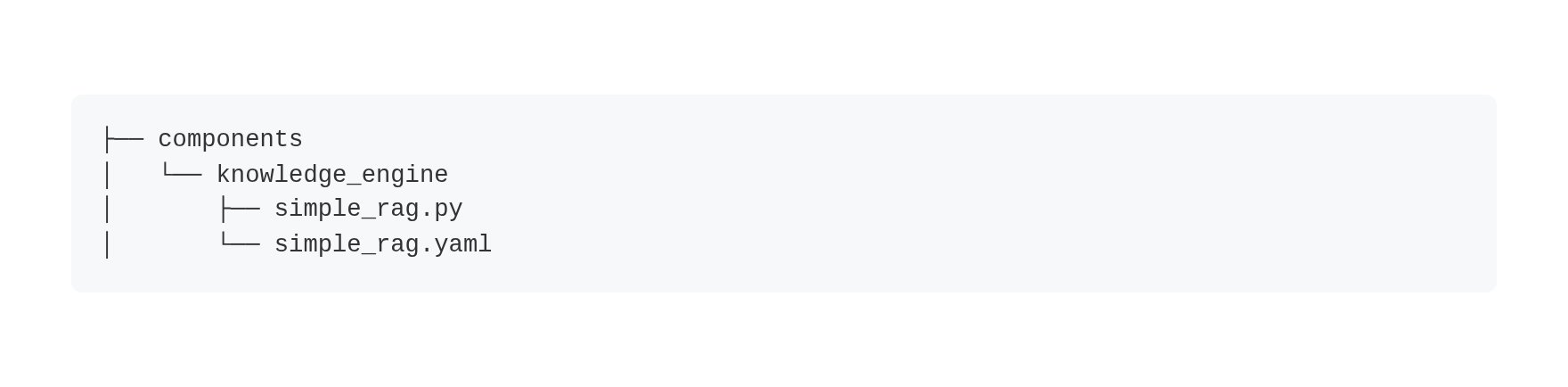
Define Configuration Schemas
The YAML manifest defines two configuration schemas:
creation_schema: Parameters filled when creating a knowledge base (e.g., chunk size, embedding model)retrieval_schema: Parameters adjustable at retrieval time (e.g., score threshold, top-K)
spec:
  creation_schema:
    - name: chunk_size
      label:
        en_US: Chunk Size
      type: integer
      default: 500
    - name: chunk_overlap
      label:
        en_US: Chunk Overlap
      type: integer
      default: 50
  retrieval_schema:
    - name: score_threshold
      label:
        en_US: Score Threshold
      type: float
      default: 0.5
LangBot dynamically renders creation and retrieval forms based on these schemas — different engines show different configuration fields.
Declare Capabilities
class SimpleRag(KnowledgeEngine):

    @classmethod
    def get_capabilities(cls) -> list[str]:
        return [
            KnowledgeEngineCapability.DOC_INGESTION,   # Supports document upload
            # KnowledgeEngineCapability.DOC_PARSING,   # Optional: built-in parsing
]| Capability | Description |
|---|---|
DOC_INGESTION | Supports document upload and processing. UI shows “Documents” tab |
DOC_PARSING | Supports built-in document parsing. Without this, an external Parser plugin is required |
Implement Core Methods
The three essential methods:
Document Ingestion:
async def ingest(self, context: IngestionContext) -> IngestionResult:
    # 1. Get file content (or use Parser's pre-parsed result)
    if context.parsed_content:
        text = context.parsed_content.text
    else:
        file_bytes = await self.plugin.get_knowledge_file_stream(
            context.file_object.storage_path
        )
        text = file_bytes.decode('utf-8')

    # 2. Chunk the text
    chunks = self._split_text(text, chunk_size=500)

    # 3. Call host embedding model
    vectors = await self.plugin.invoke_embedding(
        embedding_model_uuid, chunks
    )

    # 4. Write to host vector database
    await self.plugin.vector_upsert(
        collection_id, vectors, ids, metadata
    )

    return IngestionResult(
        document_id=context.file_object.metadata.document_id,
        status=DocumentStatus.COMPLETED,
        chunks_created=len(chunks),
    )
Knowledge Retrieval:
async def retrieve(self, context: RetrievalContext) -> RetrievalResponse:
    # 1. Generate query vector
    query_vectors = await self.plugin.invoke_embedding(
        embedding_model_uuid, [context.query]
    )

    # 2. Vector search
    results = await self.plugin.vector_search(
        collection_id, query_vectors[0], top_k=5
    )

    # 3. Convert and return
    return RetrievalResponse(results=entries, total_found=len(entries))
Document Deletion:
async def delete_document(self, kb_id: str, document_id: str) -> bool:
    deleted = await self.plugin.vector_delete(
        collection_id=kb_id, file_ids=[document_id]
    )
    return deleted > 0
Bridging External Services
If your goal is to bridge Dify, RAGFlow, FastGPT, or other external services rather than building a custom RAG pipeline, the implementation is even simpler — don’t declare DOC_INGESTION capability and only implement retrieve:
class DifyRAGEngine(KnowledgeEngine):

    @classmethod
    def get_capabilities(cls) -> list[str]:
        return []  # No document upload — managed externally

    async def retrieve(self, context: RetrievalContext) -> RetrievalResponse:
        # Call Dify/RAGFlow/FastGPT retrieval API
        ...
The knowledge base won’t show a “Documents” tab — all content management happens in the external service.
Building a Parser Plugin
Parser development is even more concise:
lbp comp ParserDeclare supported MIME types in the manifest:
spec:
  supported_mime_types:
    - application/pdf
    - application/vnd.openxmlformats-officedocument.wordprocessingml.document
Implement the parse method:
class PdfParser(Parser):

    async def parse(self, context: ParseContext) -> ParseResult:
        # context.file_content: raw file bytes
        # context.mime_type: detected MIME type
        # context.filename: original filename

        text = extract_text_from_pdf(context.file_content)

        return ParseResult(
            text=text,
            sections=[
                TextSection(content=page_text, heading=f"Page {i}", page=i)
                for i, page_text in enumerate(pages)
            ],
        )
Parsers also support cross-plugin invocation — a RAG engine plugin can call another plugin’s Parser:
result = await self.plugin.invoke_parser(
    plugin_author="author_name",
    plugin_name="plugin_name",
    storage_path=context.file_object.storage_path,
    mime_type=context.file_object.metadata.mime_type,
    filename=context.file_object.metadata.filename,
)
Upgrade Notes
- Knowledge bases created in previous versions are automatically migrated. After updating, visit the Knowledge Base page to verify.
- The
KnowledgeRetrievercomponent is deprecated. Existing plugins need to migrate toKnowledgeEngine. - Browse the Plugin Marketplace for available RAG engine plugins.
The Bigger Picture
v4.9.0’s knowledge base refactoring is the latest step in LangBot’s plugin-first evolution. From event handlers and tools in v4.0, to knowledge retrievers, to now full RAG engines and parsers — LangBot’s core capabilities are progressively moving from “built-in” to “pluggable.”
The endgame: LangBot’s core provides pipeline orchestration and infrastructure; all business capabilities are plugin-driven.
Custom chunking strategy? Write a KnowledgeEngine plugin. PDF parsing? Write a Parser plugin. Bridge your company’s internal knowledge service? Also a plugin.
Knowledge, without borders.
Links: